Power Products Manufacturer: How TOUKOO Connects R&D, Quality and Production
Choosing a reliable power products manufacturer involves more than finding a supplier with a suitable product. For distributors, retailers, electrical brands, and furniture manufacturers, a dependable manufacturing partner should be able to connect product development, engineering, quality management, and production. These capabilities influence how efficiently a product moves from an initial concept to a finished […]
Choosing a reliable power products manufacturer involves more than finding a supplier with a suitable product. For distributors, retailers, electrical brands, and furniture manufacturers, a dependable manufacturing partner should be able to connect product development, engineering, quality management, and production.
These capabilities influence how efficiently a product moves from an initial concept to a finished product ready for its target market.
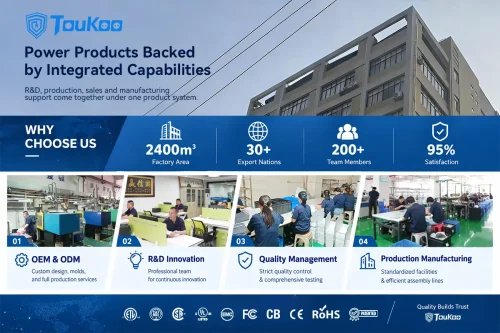
At TOUKOO, research and development, production, sales, and manufacturing support work together within one product system. As a socket brand of Zhongshan Jitonglong Plastic Hardware Products Co., Ltd., TOUKOO focuses on power strips, sockets, desktop power solutions, and customized electrical products.
In this article, we explore four key capabilities behind TOUKOO's approach to power product manufacturing: OEM/ODM services, R&D innovation, quality management, and production manufacturing.
1. OEM & ODM: Turning Customer Requirements into Product Solutions
Every market has different requirements. A distributor may need a specific outlet configuration, while a furniture brand may be looking for a hidden power solution that fits a particular desk design. Retailers and private-label businesses may also need customized branding, packaging, or product functions.
This is where OEM and ODM capabilities become valuable.
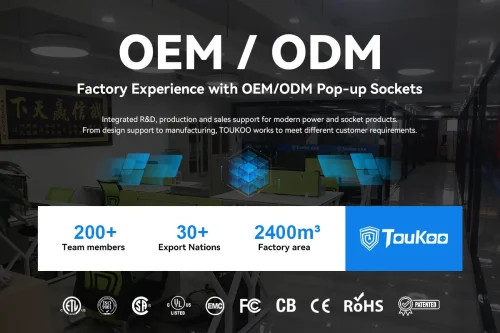
OEM (Original Equipment Manufacturing) generally involves manufacturing products according to a customer's specifications. ODM (Original Design Manufacturing) may involve a broader development role, where the manufacturer helps develop or adapt a product based on the customer's requirements.
Depending on the product and project scope, customization discussions may cover:
- Product structure and dimensions
- AC outlet quantity and configuration
- USB-A and USB-C charging options
- Housing materials and colors
- Product appearance and branding
- Logo placement and private labeling
- Packaging and product documentation
- Mold development and tooling requirements
A practical OEM/ODM process begins with understanding the application, target market, technical requirements, and expected order scope. The manufacturer can then evaluate which existing product platforms are suitable and which changes may be feasible.
For buyers, this approach can make it easier to develop products that match their brand positioning and market needs.
To learn more about the project process, read how TOUKOO supports global OEM/ODM projects.
2. R&D Innovation: Building the Foundation Before Production
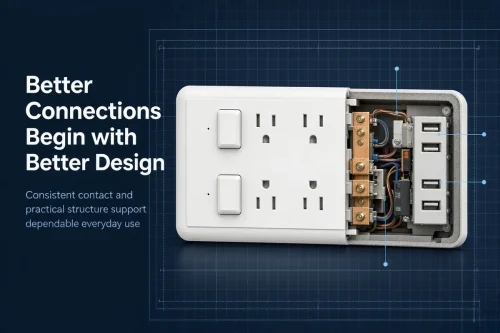
A power product may look simple from the outside, but its internal structure requires careful engineering.
The design must accommodate electrical components, conductive parts, wiring, switches, charging modules, protective structures, and housing dimensions. For furniture-integrated products, the design must also consider installation space, mounting requirements, and the appearance of the surrounding furniture.
An in-house R&D team can help connect these requirements during product development.
Key development considerations may include:
Product structure: The internal layout and external dimensions need to work together to create a practical and manufacturable design.
Electrical configuration: Outlet arrangements, charging modules, wiring, and component selection must be evaluated according to the intended product specifications.
Mold and tooling development: Accurate molds help support the production of consistent plastic components and product housings.
Design for manufacturing: Product designs should consider assembly methods, component positioning, material selection, and production feasibility.
TOUKOO's company information highlights in-house R&D, 3D modeling, and precision mold-making as part of its product development capabilities. These resources help connect design decisions with manufacturing requirements.
The goal is not simply to create a product concept, but to develop a solution that can be evaluated, refined, and prepared for production.
3. Quality Management: Building Consistency into Every Stage
Quality is not determined by the appearance of a finished product alone. It depends on the materials, components, design, assembly, testing, and production controls behind it.
For a power products manufacturer, quality management should be considered throughout the manufacturing process rather than only at the final inspection stage.
A structured quality approach may involve several areas:
Material and component evaluation
Materials and electrical components should be selected according to the product's specifications and intended application. Their ratings, dimensions, and compatibility with the product design need to be considered.
Production process control
Consistent assembly methods and defined production procedures help reduce avoidable variation between units. Appropriate checks during manufacturing can also help identify problems before products reach the final inspection stage.
Product testing and inspection
Testing should reflect the product category and its intended use. Depending on the model, relevant evaluations may include electrical performance, functional operation, mechanical performance, and other applicable safety checks.
Documentation and compliance
Product specifications, labels, instructions, and test records should accurately reflect the finished product. Buyers should confirm which standards, certificates, and reports apply to the exact model and destination market.
TOUKOO highlights multi-stage testing and quality assurance as part of its manufacturing approach. For buyers, reviewing model-specific specifications and supporting documents remains an important step before confirming an order.
For more background on the technical side of power product construction, explore power strip internal design and safety considerations.
4. Production Manufacturing: From Product Design to Assembly
Once a product design has been evaluated and its requirements have been confirmed, production manufacturing brings the solution into physical form.
Manufacturing capabilities are not limited to final assembly. They may involve several connected processes, including:
- Plastic component and housing production
- Mold and tooling coordination
- Hardware component preparation
- Electrical component integration
- Product assembly
- Functional inspection and quality checks
- Packaging and preparation for shipment
The coordination between these processes matters. A change in product dimensions, housing structure, or component layout may affect tooling, assembly, and inspection requirements.
TOUKOO's company profile highlights automated production facilities and manufacturing support as part of its integrated capabilities. Standardized production arrangements and assembly processes can help support consistent manufacturing, while coordination between R&D and production helps address design and assembly requirements.
For buyers, it is useful to understand not only what a manufacturer can produce, but also how product development, tooling, assembly, and quality management work together.
5. Integrated Capabilities for Global Power Product Projects
OEM/ODM, R&D, quality management, and production are most valuable when they work as connected capabilities.
Consider a project involving a customized desktop power socket:
- Requirement discussion: The customer defines the target market, product application, outlet configuration, charging requirements, and branding needs.
- Design and development: The R&D team evaluates the product structure, dimensions, components, materials, and possible customization.
- Manufacturing preparation: Tooling, components, assembly methods, and production requirements are reviewed.
- Quality evaluation: The product is checked against its confirmed specifications and applicable testing requirements.
- Production and delivery: After the required approvals, the project moves into manufacturing, inspection, packaging, and shipment.
The exact workflow depends on the product and project. Some projects may use an existing product platform, while others may require additional design or tooling work.
An integrated approach can improve communication between teams, reduce unnecessary handoffs, and make it easier to coordinate product requirements throughout development and manufacturing.
6. Supporting Customers Across International Markets
Power products are sold into markets with different electrical requirements, product preferences, installation environments, and compliance expectations.
A manufacturer serving international customers needs to understand these differences and communicate clearly throughout the project.
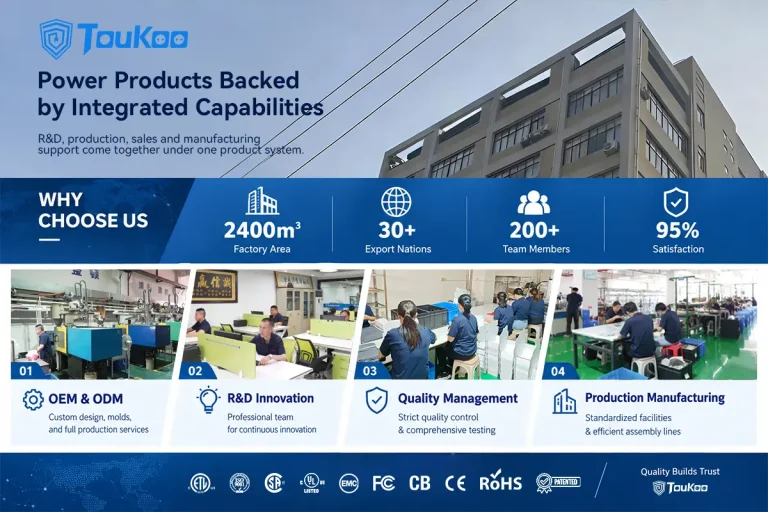
TOUKOO's company profile highlights business coverage across 30+ countries, a team of more than 200 members, and a 95% customer satisfaction figure. These company-reported indicators reflect its international business focus and customer-service positioning.
For overseas distributors, retailers, wholesalers, and brand owners, effective cooperation also depends on clear communication about:
- Target market and electrical specifications
- Product configuration and customization scope
- Samples and specification confirmation
- Packaging, labeling, and branding
- Applicable certification and documentation
- Production planning and delivery expectations
Certification requirements should always be checked against the exact product model and destination market. A certification or management-system mark displayed in general company materials should not be interpreted as proof that every product carries the same approval.
For a broader introduction to quality management systems, see ISO's overview of quality management systems.
7. Explore TOUKOO's Power Product Capabilities
TOUKOO focuses on power strips, pop-up sockets, desktop sockets, furniture-integrated power solutions, and related electrical products.
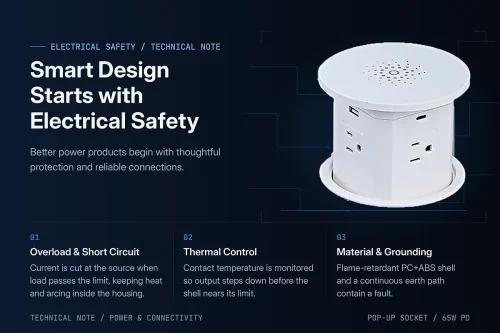
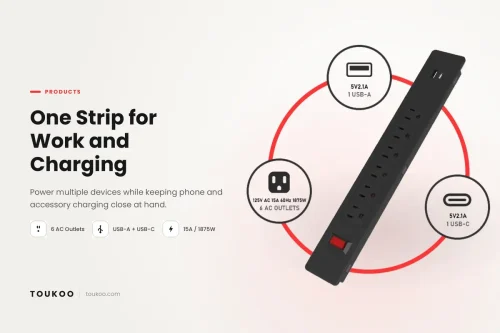
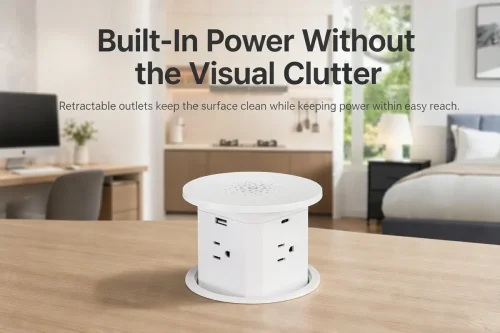
Different product formats serve different environments. Pop-up sockets can be integrated into desks and worktops, while desktop power strips provide accessible power connections for everyday workspaces.
You can explore TOUKOO's pop-up socket product range and TOUKOO's desktop socket product range to review available product formats.
For businesses looking for a manufacturing partner, the right solution begins with a clear understanding of the product application, target market, technical specifications, and customization requirements.
Build Your Next Power Product with TOUKOO
A capable power products manufacturer should bring together more than production equipment. Product development, engineering, quality management, manufacturing, and customer communication all contribute to a successful project.
By connecting OEM/ODM services, R&D innovation, quality assurance, and production manufacturing, TOUKOO works to support power product projects for customers in different markets.
Whether you are sourcing an existing socket product, developing a private-label power strip, or exploring a customized furniture-integrated power solution, the first step is to define your requirements clearly.
To discuss your product ideas and sourcing needs, contact TOUKOO about your power product project.
Frequently Asked Questions
What should I look for in a power products manufacturer?
Look for relevant product experience, R&D capabilities, manufacturing resources, quality management procedures, customization options, and clear communication. You should also confirm that the manufacturer can provide the documentation required for your target market.
What is the difference between OEM and ODM?
OEM generally means manufacturing according to a customer's specifications. ODM usually involves a broader product development role, where the manufacturer helps design or adapt a product based on the customer's requirements. The exact scope should be agreed upon for each project.
Why is in-house R&D important for power product manufacturing?
In-house R&D can help coordinate product structure, component selection, mold development, and design adjustments. This can make communication between product development and manufacturing more direct.
How does quality management affect power product manufacturing?
Quality management helps establish consistent processes for materials, components, assembly, inspection, and testing. It also supports better documentation and process improvement.
Can TOUKOO support customized power products?
TOUKOO provides OEM/ODM support for power product projects. Available customization options depend on the product platform, technical requirements, and project scope. Buyers should confirm feasibility with the TOUKOO team before finalizing specifications.