Pop-Up Socket Safety Design: 3 Key Priorities for Modern Power Solutions
A modern pop-up socket does more than provide convenient access to power. Its internal electrical design, temperature management, housing materials, and grounding arrangement all contribute to how the product performs in everyday use. Understanding pop-up socket safety design helps buyers, product developers, and sourcing teams evaluate power solutions beyond appearance and outlet configuration. For products […]
A modern pop-up socket does more than provide convenient access to power. Its internal electrical design, temperature management, housing materials, and grounding arrangement all contribute to how the product performs in everyday use. Understanding pop-up socket safety design helps buyers, product developers, and sourcing teams evaluate power solutions beyond appearance and outlet configuration.
For products that combine AC outlets with USB charging, these considerations become especially important. A 65W Power Delivery (PD) charging configuration, for example, needs to be evaluated not only for charging performance, but also for electrical protection, heat management, and the requirements of its intended market.
This article explores three important areas of electrical safety design and explains what to look for when assessing a pop-up socket.
1. Overload and Short-Circuit Protection
Overload and short-circuit protection are important considerations in the design of electrical power products.
An overload occurs when connected equipment draws more current than a circuit or component is designed to handle. A short circuit creates an unintended low-resistance path that can cause a rapid increase in current. Depending on the product's design, protective components may interrupt the current or disconnect the affected circuit when an abnormal condition occurs.
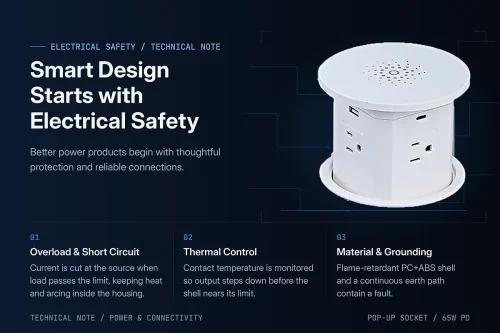
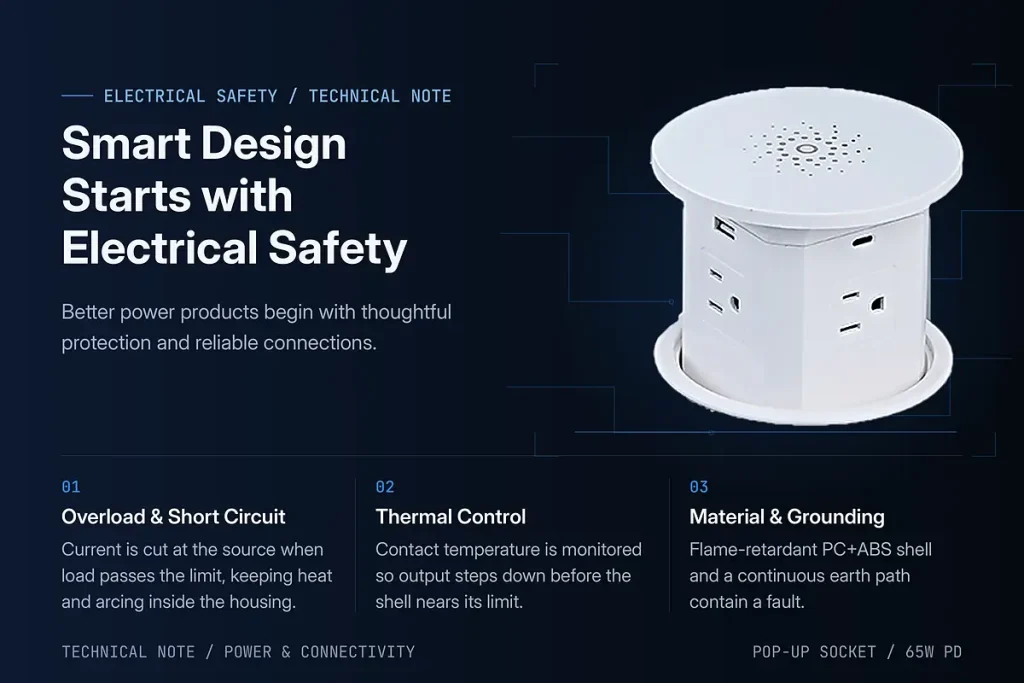
The technical visual for this pop-up socket highlights overload and short-circuit protection. For a model equipped with a verified protection mechanism, the engineering objective is to reduce the risk associated with excessive current and electrical faults.
When evaluating this type of protection, buyers should look beyond a general feature label and confirm the details of the design.
Key questions include:
- What type of overload or short-circuit protection is used?
- Under what conditions does the protection activate?
- Does the protection interrupt the affected circuit or disconnect the product from its power source?
- What test reports or technical documentation are available for the exact model?
- Are the protection features appropriate for the intended market and application?
These details matter because protection mechanisms are not identical across all power products. The presence of multiple outlets, USB charging, or a compact housing does not automatically confirm that a product includes a particular protection function.
2. Thermal Control and Heat Management
Temperature management is another important part of pop-up socket safety design.
Electrical components generate heat during operation. USB charging circuits, power conversion components, and other internal electronics can contribute to the overall thermal load. In a compact pop-up socket, the available space for heat dissipation may be limited, making thermal design an important engineering consideration.
The supplied technical visual describes a thermal-control concept in which contact temperature is monitored and output is reduced before the housing approaches its specified temperature limit. If this feature is included in the actual product, it can help manage operating temperature under the conditions defined by the design.
Effective thermal management may involve several elements:
- Selecting components with suitable electrical and thermal ratings
- Designing circuit layouts and enclosures with heat dissipation in mind
- Evaluating temperature rise under specified operating conditions
- Defining appropriate limits for charging output or operating current
- Testing the product under normal use and relevant abnormal conditions
For a 65W PD pop-up socket, thermal performance deserves particular attention because the charging power, conversion efficiency, internal component selection, and enclosure design work together to influence heat generation.
Buyers should confirm how the product behaves at its rated output, whether output reduction or thermal shutdown is supported, and which test conditions were used to validate the design. A general reference to thermal control should not be treated as proof of a specific protection function unless the product documentation confirms it.
3. Housing Materials and Grounding Design
A product's external housing and internal grounding arrangement are also important parts of electrical safety engineering.
Choosing suitable housing materials
The technical visual identifies a flame-retardant PC+ABS housing. PC+ABS is a material blend combining polycarbonate (PC) and acrylonitrile butadiene styrene (ABS). Its suitability for a particular electrical product depends on the selected grade, design, operating environment, and applicable requirements.
For a pop-up socket, material selection should consider factors such as:
- Mechanical strength and resistance to everyday handling
- Dimensional stability during normal operating temperatures
- Suitability for the product's intended environment
- Relevant flammability and material test requirements
- Compatibility with the product's construction and manufacturing process
It is important not to assume that every PC+ABS material has the same flame-retardant performance. The specific grade and its supporting documentation should be checked before making a published flame-retardancy claim.
Maintaining an appropriate grounding path
Grounding design is another important consideration for products that require protective earthing. A properly designed grounding path provides a defined route for fault current under the conditions for which the product is designed. This can help protective devices operate as intended and reduce the risk of hazardous touch voltages.
The grounding arrangement must be appropriate to the product's electrical architecture. Buyers should confirm whether protective grounding is required for the specific model, how the grounding path is constructed, and how its continuity is verified during production or testing.
Material selection and grounding should therefore be assessed as part of the complete product design, not as isolated marketing features.
4. What Makes Safety Design Important in a 65W PD Pop-Up Socket?
A pop-up socket with USB Power Delivery combines conventional AC power access with electronic charging functionality. This creates several design considerations that need to be evaluated together.
AC power and USB charging
The AC outlets and USB charging circuitry may have different operating requirements. The product specification should clearly identify the AC ratings, USB output ratings, and any limits that apply when multiple ports are used simultaneously.
Power conversion and temperature rise
USB PD charging requires power conversion electronics. Their performance, component ratings, circuit design, and thermal characteristics all influence the product's behavior under load.
Protection under abnormal conditions
Overload, short circuit, and excessive temperature are different conditions. A design may use different protective components or control strategies for each, so buyers should confirm which functions are included and how they are validated.
Installation and intended use
Pop-up sockets are often integrated into desks, worktops, or furniture. Installation dimensions, clearance, ventilation, cable routing, and the surrounding materials can all affect the final installation. The manufacturer's instructions should define the permitted installation conditions.
For buyers comparing different formats, TOUKOO's pop-up socket for desk guide provides a useful starting point for understanding how pop-up sockets fit into modern workspaces.
5. How Buyers Can Evaluate Electrical Safety Claims
Product descriptions often use terms such as overload protection, thermal control, flame-retardant materials, grounding, and surge protection. These terms refer to different features and should not be treated as interchangeable.
A practical technical review should cover the following areas.
Product specifications: Confirm the rated voltage, current, AC power, USB output, and supported charging protocols for the exact model.
Protection functions: Identify the actual overload, short-circuit, overtemperature, or other protection mechanisms included in the design.
Material documentation: Verify the material grade and the relevant test evidence before making claims about flame-retardant performance.
Grounding and construction: Confirm the grounding arrangement where applicable and review the corresponding continuity or electrical safety test information.
Testing and market requirements: Check the product's applicable standards, test reports, certification status, and intended market. Do not infer certification from a logo shown in general marketing artwork.
UL Solutions explains that power strips and related power distribution products can fall into different categories and that their applicable evaluation requirements depend on the product type. Its guide to power strips and surge protectors is a useful reference for understanding the distinction between basic power distribution and surge protection.
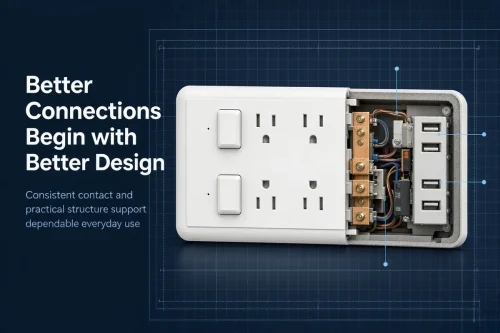
For product sourcing and engineering discussions, it is also helpful to review TOUKOO's power strip internal design overview for additional context on power-product construction.
6. Integrating Safety Considerations into Product Development
For manufacturers and brand owners, electrical safety should be considered throughout product development rather than added as a final checklist item.
A structured process may include:
- Define the intended application. Establish the target market, installation environment, rated electrical requirements, and expected usage.
- Select the appropriate architecture. Determine the outlet configuration, USB charging solution, circuit protection approach, grounding requirements, and enclosure design.
- Review components and materials. Check component ratings, material specifications, and suitability for the intended operating conditions.
- Validate the design. Carry out the testing and evaluation required for the product and its target market.
- Maintain production consistency. Use appropriate inspection and production controls to help ensure that manufactured units match the validated design.
- Prepare product documentation. Ensure that specifications, labels, instructions, and any compliance statements accurately reflect the finished product.
The exact process depends on the product category, design, and destination market. No single feature or test should be presented as proof that a product meets every applicable safety requirement.
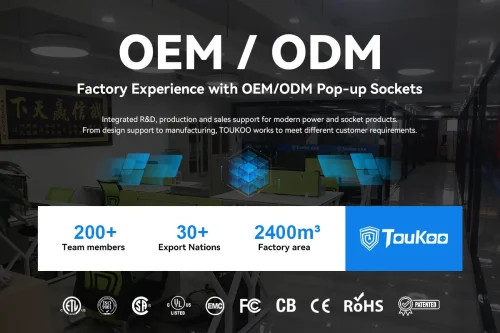
Businesses looking for a product development partner can learn more about TOUKOO's OEM/ODM power-product support. Project scope, customization options, testing, and documentation should be confirmed according to the specific product requirements.
Build Better Power Products Through Thoughtful Engineering
A well-designed pop-up socket brings together electrical performance, heat management, appropriate materials, and a grounding arrangement suited to its design. These elements work together to support dependable operation and help address electrical risks.
When evaluating a 65W PD pop-up socket, buyers should review the complete technical specification rather than relying on a single headline feature. Confirm the protection mechanisms, thermal performance, material grade, grounding details, and evidence supporting any safety or compliance claims.
To discuss product specifications, application requirements, or OEM/ODM opportunities, contact TOUKOO's team.
Frequently Asked Questions
What is overload protection in a pop-up socket?
Overload protection is a design measure intended to respond when current exceeds a defined limit. The actual response depends on the protective components and circuit architecture used in the product.
Is overload protection the same as short-circuit protection?
No. An overload and a short circuit are different electrical conditions. A product may use related or separate protection mechanisms, so the exact functions should be confirmed in its technical documentation.
Why is thermal control important in a 65W PD pop-up socket?
USB charging circuits generate heat during power conversion. Thermal design helps keep operating temperatures within the product's specified limits under defined conditions. The actual control strategy should be verified for the model.
Does a PC+ABS housing automatically mean a product is flame-retardant?
No. Performance depends on the specific material grade and supporting test evidence. A flame-retardancy claim should be based on documentation for the material and finished product, where applicable.
Does every pop-up socket require grounding?
Grounding requirements depend on the product's electrical design, construction, and applicable standards. Buyers should check the exact model's specifications and installation instructions rather than assume that all products use the same grounding arrangement.