Power Strip Internal Design: How Safer Power Is Engineered for Everyday Spaces
A power strip looks simple from the outside. Plug it into a wall outlet, connect several devices, turn on the switch, and power becomes available wherever it is needed. But inside the housing, the engineering is much more complex. A well-engineered power strip internal design must manage electrical current, mechanical contact, heat, switching, grounding, insulation, […]
A power strip looks simple from the outside. Plug it into a wall outlet, connect several devices, turn on the switch, and power becomes available wherever it is needed.
But inside the housing, the engineering is much more complex.
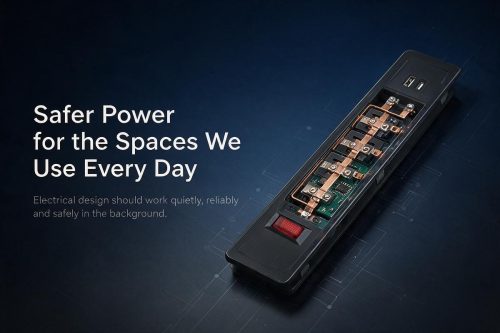
A well-engineered power strip internal design must manage electrical current, mechanical contact, heat, switching, grounding, insulation, and protection within a compact enclosure. Each element plays a role in determining how reliably the product performs during everyday use.
For homes, offices, workstations, furniture systems, and commercial spaces, safer power begins with what users cannot see: the architecture inside the product.
Why Power Strip Internal Design Matters
As more devices share the same power source, the internal components of a power strip must carry electrical current consistently while managing heat and maintaining reliable connections.
Poor electrical connections, inadequate conductors, damaged cords, or overloaded power strips can create safety risks. The U.S. Consumer Product Safety Commission advises consumers not to overload power strips and has identified issues such as undersized wiring and loose electrical connections in unsafe electrical products.
That is why good power strip safety design cannot depend on a single component.
It is a system.
Conductors, socket contacts, switches, protective components, housing materials, wiring, and product ratings all need to work together.
1. The Current Path: Where Electrical Safety Begins
Electricity entering a power strip must travel from the power cord through internal conductors before reaching each outlet.
This current path may appear straightforward, but conductor design has a major influence on electrical performance.
Copper is commonly used for electrical conduction because of its high conductivity. In a properly engineered design, conductor dimensions, connection points, contact resistance, and current capacity must all be considered together.
The goal is not simply to use “more copper.”
The objective is to create a low-resistance and mechanically stable current path that can carry the intended electrical load without unnecessary heat buildup.
A well-designed internal conductor system also helps distribute current consistently across multiple outlets.
This is especially important when several devices operate simultaneously.
2. Copper Conductors and Busbar Architecture
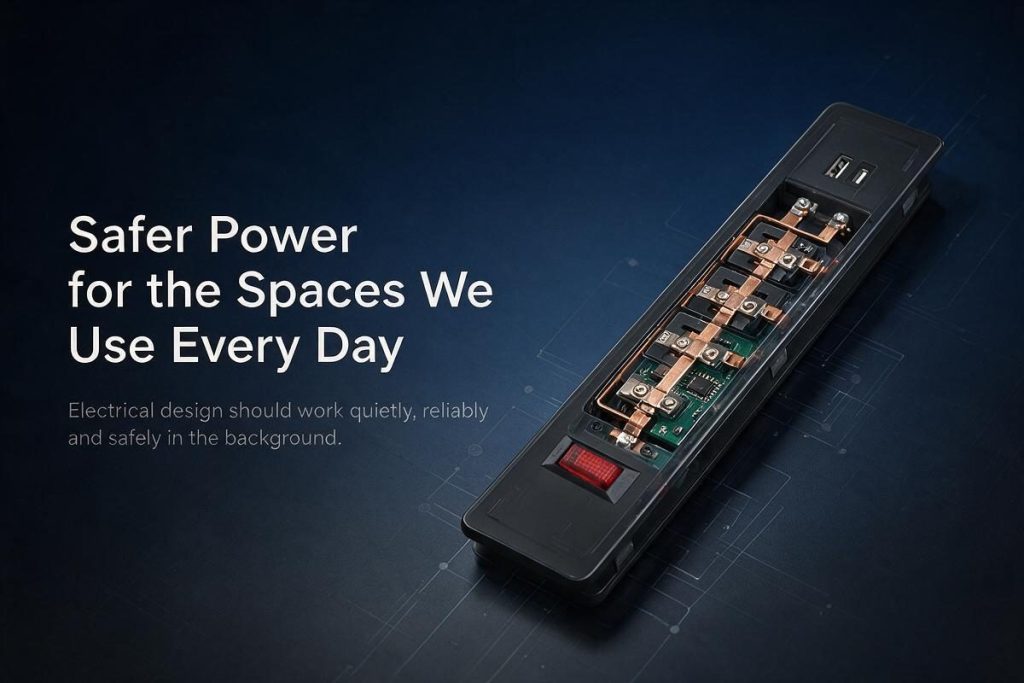
Inside many multi-outlet power products, conductive strips or busbars are used to distribute electricity efficiently from the incoming power source to individual receptacles.
Their design affects more than conductivity.
Engineers must consider:
Conductor cross-section, because current capacity and resistance are related to conductor dimensions.
Connection quality, because weak or inconsistent joints can increase electrical resistance.
Mechanical stability, because internal conductive structures must remain securely positioned during normal product use.
Heat behavior, because electrical resistance generates heat and concentrated hot spots should be minimized.
TOUKOO has previously highlighted high-quality copper strips and low-impedance wiring as part of its approach to stable power distribution.
The important point is that conductor material alone does not determine product safety. Material selection, geometry, assembly quality, electrical rating, and testing must be considered as one engineering system.
3. Contact Pressure: A Small Detail With a Big Role
Every time a plug is inserted into an outlet, metal contacts inside the receptacle must hold the plug blades securely.
This creates another critical part of power strip internal design: contact geometry and contact pressure.
Reliable contact helps maintain a stable electrical connection.
If a connection becomes loose or inconsistent, resistance at the contact point can increase. Higher resistance can generate additional heat, particularly when the product is carrying significant current.
For this reason, socket engineering involves more than the visible outlet shape.
Material properties, spring force, dimensional tolerances, manufacturing consistency, and long-term mechanical durability all matter.
The safest design is one in which electrical and mechanical engineering work together.
4. Overload Protection: Responding When Current Becomes Too High
A power strip is designed for a specified electrical load.
Connecting too much equipment can cause the total current demand to exceed the product's intended rating.
This is where overload protection becomes important.
Depending on the product design, a power strip may include a circuit breaker, thermal protection device, or another form of supplementary overcurrent protection.
UL Solutions notes that power strips often incorporate circuit breakers designed to interrupt current during overload or short-circuit conditions.
This is different from simply having an on/off switch.
A normal switch gives the user manual control.
An overload protection mechanism is designed to respond to abnormal operating conditions according to its intended design.
For manufacturers and buyers, these protection functions should always be matched to the specific product, electrical rating, intended market, and applicable certification requirements.
5. Overload Protection and Surge Protection Are Not the Same
This distinction is particularly important.
Overload protection addresses excessive current.
Surge protection addresses short-duration increases in voltage.
They solve different electrical problems.
Some power products may include both functions, while others may include only one or neither, depending on the product category and specification.
In the United States, UL Solutions identifies UL 1363 as the primary standard used to investigate relocatable power taps. If a relocatable power tap incorporates a surge protective device, that surge protective function must also comply with the relevant requirements of UL 1449.
This is why manufacturers and distributors should avoid using terms such as “surge protector” unless the function is actually included and supported by the appropriate product specification and evaluation.
For TOUKOO products, features should therefore always be confirmed according to the specific model rather than assumed across the entire product range.
6. Thermal Design: Managing Heat Before It Becomes a Problem
Heat is one of the most important engineering considerations inside electrical products.
Every conductor and connection has some electrical resistance.
When current passes through resistance, heat is generated.
The challenge is to keep that heat within appropriate operating limits.
Good thermal design can involve several factors working together:
appropriate conductor dimensions, stable electrical contacts, secure connections, component spacing, suitable housing materials, and protection mechanisms appropriate to the electrical load.
The internal layout also matters.
Components that generate heat need to be positioned so that heat does not unnecessarily concentrate around sensitive parts.
For products integrating AC outlets, switching components, USB charging modules, or additional electronics, thermal management becomes even more important because more functions are being placed inside the same enclosure.
7. Housing and Insulation Are Part of the Electrical System
The outer housing is not simply a cosmetic shell.
It helps separate users from energized internal components while supporting switches, receptacles, circuit boards, conductors, and other internal structures.
Inside the product, insulation distances and component positioning also help prevent unintended electrical contact.
Depending on the model and intended market, manufacturers may use flame-retardant materials and other material technologies to support the overall safety design.
However, material selection should never be viewed in isolation.
A flame-retardant enclosure cannot compensate for an incorrectly designed electrical system.
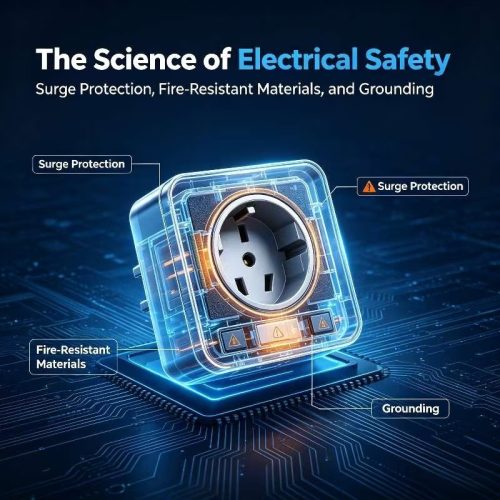
Electrical safety is strongest when conductor design, overload protection, grounding, insulation, housing, and manufacturing quality work together.
8. Adding USB Charging Changes the Engineering Challenge
Modern power strips increasingly combine traditional AC outlets with USB-A, USB-C, and other charging functions.
This creates additional engineering requirements.
AC mains power and low-voltage charging electronics must coexist inside a relatively compact enclosure.
Design engineers therefore need to consider circuit separation, power conversion, insulation, component temperature, charging control, and electromagnetic behavior in addition to traditional socket architecture.
A power strip is no longer necessarily just a passive group of outlets.
In many modern designs, it becomes a compact power-distribution and charging platform.
TOUKOO's current product portfolio includes traditional power products as well as desktop, furniture-integrated, and USB-enabled power solutions, reflecting this wider role of modern power distribution products.
9. Safety Must Be Designed Before the Product Reaches the User
Quality inspection is important, but product safety cannot be created only at the final inspection stage.
It needs to begin during engineering.
The process starts with defining electrical requirements and then continues through structural design, material selection, component sourcing, tooling, assembly, testing, and production control.
Even small manufacturing variations can affect how components fit together.
That is why dimensional control and consistent assembly are especially important for electrical contacts, conductive components, switches, housing parts, and protection mechanisms.
TOUKOO positions electrical safety as one of its core technology priorities and highlights safety systems, surge suppression, grounding, fire-resistant construction, quality control, and OEM/ODM development across its website.
The exact protection features and certifications, however, should always be confirmed for each individual product model and target market.
10. What B2B Buyers Should Look for Inside a Power Strip
For distributors, retailers, furniture manufacturers, and private-label brands, evaluating a power strip should go beyond appearance and outlet count.
Start with the electrical rating.
Then examine the conductor and cord specifications, contact architecture, grounding design, overload protection, material requirements, switching system, charging functions, and applicable certification.
It is also worth asking how the product is tested during development and production.
A good supplier should be able to explain not only what the product does, but also how its internal architecture supports that function.
This is particularly important for OEM/ODM projects, where changing the number of outlets, cable length, USB power, housing geometry, or electrical rating can affect the engineering of the entire system.
Engineering Safer Power for Everyday Spaces
The safest electrical technology is often invisible.
Users may never see the conductive pathways, contact structures, protection mechanisms, insulation, or circuitry operating beneath the housing.
But those components determine how a power product behaves every time a device is connected.
Good power strip internal design is therefore not about one headline feature.
It is about creating a complete electrical system in which current distribution, mechanical contact, thermal performance, protection, materials, and manufacturing quality support one another.
At TOUKOO, this system-level approach is central to the development of power strips, desktop sockets, furniture power solutions, and customized OEM/ODM products.
Because safer power should not demand attention.
It should work quietly, reliably, and safely in the background of the spaces we use every day.
Frequently Asked Questions
What is power strip internal design?
Power strip internal design refers to the arrangement and engineering of conductors, socket contacts, switches, grounding components, protection devices, insulation, circuitry, and housing structures inside a power strip.
Why are copper conductors used in power strips?
Copper offers high electrical conductivity and is widely used in electrical conductors. However, overall performance also depends on conductor dimensions, connection quality, product rating, mechanical construction, and manufacturing consistency.
Is overload protection the same as surge protection?
No. Overload protection responds to excessive current, while surge protection is designed to address transient increases in voltage. A product should only be described as a surge protector when that capability is actually included and supported by the product specification.
What standard applies to power strips in the United States?
The applicable standard depends on the specific product category. UL Solutions identifies UL 1363 as the basic U.S. standard for relocatable power taps, while surge protective devices incorporated into such products must additionally comply with applicable UL 1449 requirements.
Can power strip internal design be customized for OEM/ODM projects?
Yes. Depending on the project, customization may involve outlet configuration, electrical rating, charging modules, cable specifications, switches, housing structure, materials, branding, and other requirements. Each change should be evaluated as part of the complete electrical design.